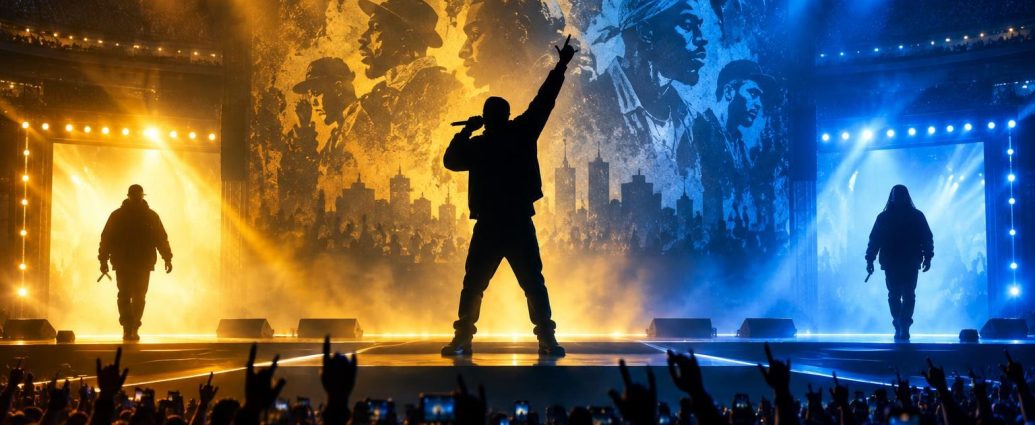
Jay-Z’s year-long JAY-Z30 celebration has officially reached its final act, and the closer played like a cross-country coronation. The hip-hop icon wrapped the Los Angeles finale at SoFi Stadium in Inglewood over the weekend, with Dr. Dre, Snoop Dogg and Too $hort joining the stage for a West Coast-heavy sendoff that put legacy, catalog and cultural memory at the center of the night.
The show landed as the final chapter of a broader anniversary campaign built around 30 years of Reasonable Doubt, Jay-Z’s 1996 debut album. Roc Nation announced the JAY-Z30 initiative in June as a year-long celebration of his music, storytelling, entrepreneurship and cultural influence, with activations, merchandise, archival experiences and stadium performances tied to the milestone.
That context matters because the Los Angeles finale was not framed as a normal tour stop. It was the end of a curated victory lap. Live Nation had previously announced that a second Los Angeles show was added for Saturday, October 24, at SoFi Stadium, joining the original October 23 date after additional stadium shows were added in London and Los Angeles. By the time the run reached Inglewood, the narrative was already bigger than a setlist.
According to reports from Variety and Pitchfork, Jay-Z used the final night to give Los Angeles its own moment. Too $hort appeared for a Bay Area salute, while Dr. Dre and Snoop Dogg delivered the marquee guest segment with a run of West Coast classics. Pitchfork reported that the Dre and Snoop portion included The Next Episode, Still D.R.E., Nuthin’ but a ‘G’ Thang and California Love, turning the finale into a bridge between Brooklyn ambition and California hip-hop royalty.
That pairing made sense for the moment. Jay-Z’s catalog is rooted in New York, but his career has always moved nationally and globally: arena rap, boardroom power, streaming-era influence, sports partnerships and cultural institution status. Bringing Dre and Snoop into the final frame at SoFi did more than create a viral guest spot. It placed Jay’s anniversary celebration inside a larger hip-hop timeline, from the coasts that defined the genre’s commercial explosion to the stadium spaces where rap now operates as legacy entertainment.
The weekend also widened the family-and-catalog feeling of the finale. Pitchfork reported that the final SoFi shows featured appearances across both nights from Scarface, John Legend, DJ Khaled and Blue Ivy Carter, with Blue Ivy accompanying her father on piano during selected songs on the first night. That mix of guests reflected the full range of the JAY-Z30 concept: peers, collaborators, family, regional icons and songs that have moved from street-level anthems into multigenerational standards.
What stood out most about the finale was how little it needed a new announcement to feel current. In an era when every major artist appearance is immediately treated as a possible album tease, Jay-Z kept the focus on the work already on the board. Variety noted that speculation about future moves has hovered around the run, but no official new album announcement has been made. The verified story is stronger without stretching it: one of hip-hop’s most consequential catalogs just received a stadium-scale retrospective, and the final scene brought Dre, Snoop and Too $hort into the frame.
For hip-hop fans, the SoFi finale also underlined how anniversary concerts have become more than nostalgia plays. When executed at this level, they become arguments about canon. Which songs survived? Which collaborations still matter? Which artists can command a stadium not because of a new single, but because the audience wants to revisit the architecture of an entire era?
Jay-Z’s answer was clear: build the moment around the catalog, honor the cities, and let the guests sharpen the regional story. The Los Angeles closer gave West Coast legends their proper space while still keeping Jay-Z at the center of the anniversary he built. It was a reminder that Reasonable Doubt did not just introduce an artist in 1996; it launched a career that would eventually make hip-hop’s boardroom, festival, stadium and cultural archive conversations impossible to separate.
With JAY-Z30 now closed out, the bigger takeaway is not simply that a superstar brought out other superstars. It is that hip-hop’s legacy era is here, and Jay-Z is one of the few artists capable of presenting that legacy at this scale without turning it into a museum piece. At SoFi, the past was alive, loud and still moving.
