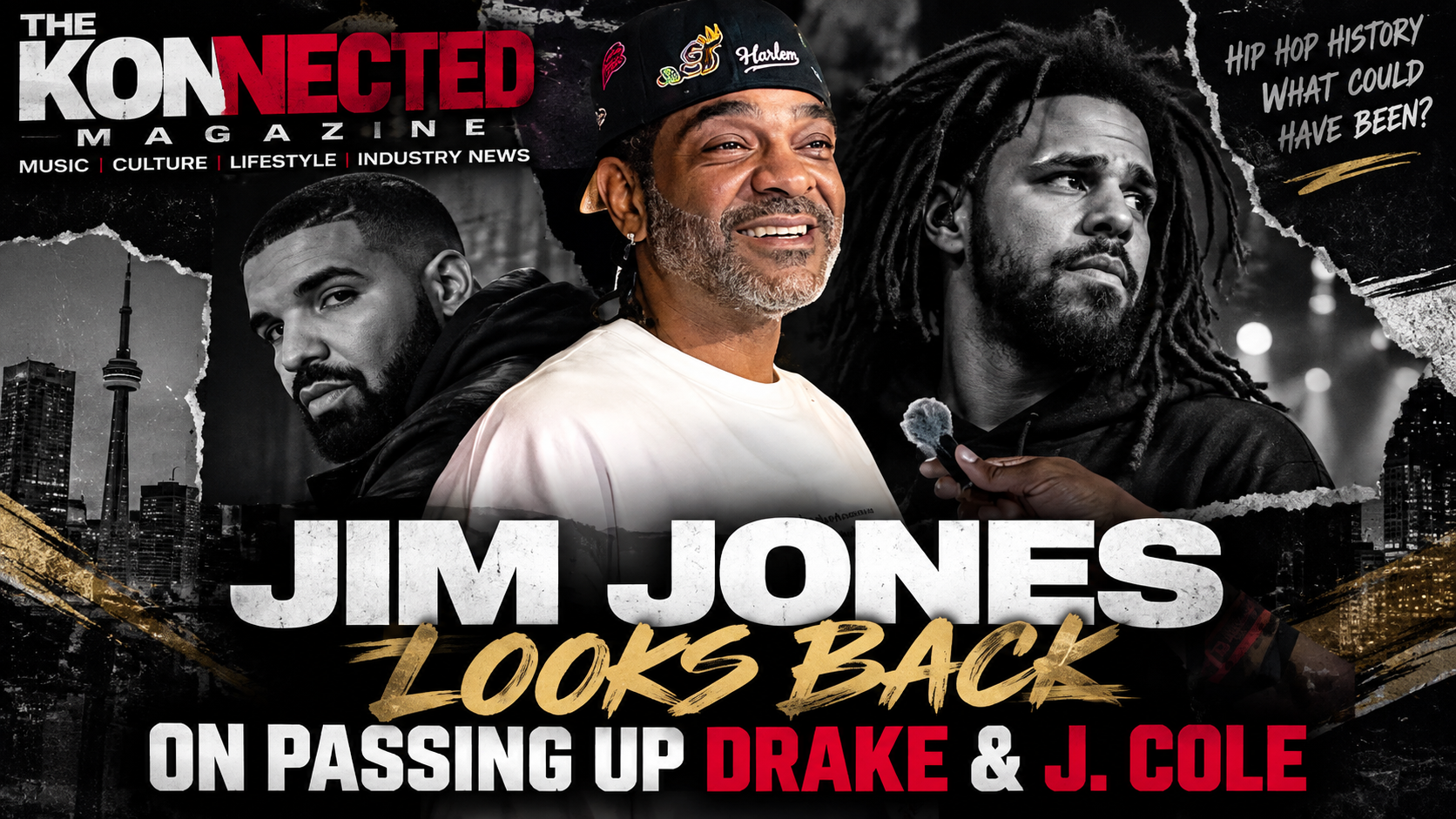
Jim Jones has built an undeniable legacy in hip-hop, but even the Dipset veteran admits there are a couple of career opportunities he wishes he could get back. Two of them just happen to involve Drake and J. Cole.
Imagine having two future rap superstars cross your path before the rest of the world fully understood their potential — and deciding to pass.
That’s a piece of hip-hop history Jim Jones can now look back on with a mixture of humor, hindsight and a little regret.
The Harlem rapper recently revisited the opportunities he had to work with both Drake and J. Cole during the early stages of their careers. At the time, neither artist had become the powerhouse name fans know today, and Jones admits he simply didn’t recognize how their styles could fit into what he understood about the music business.
Drake Didn’t Fit the Blueprint
Drake may be one of the biggest names in music today, but his introduction to the industry was anything but traditional.
Before becoming a rap superstar, the Toronto native was widely recognized for playing Jimmy Brooks on Degrassi: The Next Generation. When Drake’s music eventually landed on Jones’ radar, his background as a Canadian television actor made it difficult for the Dipset rapper to envision exactly how to market him.
Jones has previously recalled hearing Drake rap and recognizing his talent. The problem wasn’t necessarily whether Drake could make music — it was figuring out what to do with an artist who didn’t resemble the rappers Jones was accustomed to developing.
Years later, that uncertainty looks very different.
Drake eventually connected with Lil Wayne and Young Money, launching a run that transformed him from a television actor and rising rapper into one of his generation’s most commercially successful artists.
Looking back on the missed opportunity, Jones recently summed up the financial side of the decision rather simply: “I f*ed that bag up.”**
J. Cole Was Another Missed Opportunity
Drake wasn’t the only future superstar Jones encountered early.
J. Cole also crossed paths with the Harlem rapper before becoming the Grammy-winning artist behind Dreamville.
Jones has previously described a young Cole as talented, humble and reserved. But Cole’s perspective and presentation were different from the street-centered image surrounding Jones and Dipset at the time.
That difference mattered.
Jones has explained that during that era, he believed an artist’s music should strongly represent where they came from. Cole’s ambitions and storytelling didn’t immediately fit the mold Jones was familiar with, making it harder for him to recognize what the young rapper could eventually become.
Of course, Cole ultimately found his own lane.
After signing with Jay-Z’s Roc Nation, he developed into one of hip-hop’s most respected rappers while building Dreamville into a successful brand of its own.
Sometimes the Biggest Stars Don’t Look Like Stars Yet
Jones’ story highlights one of the most unpredictable parts of the music industry: recognizing potential before there’s proof.
Today, hearing that someone passed on Drake or J. Cole sounds almost unbelievable. But judging an unknown artist is very different from evaluating someone after the hit records, sold-out tours, awards and massive fanbases arrive.
Neither Drake nor Cole necessarily represented the obvious blueprint for a rap superstar when Jones first encountered them.
And that’s exactly what makes the story interesting.
Their careers ultimately proved that hip-hop was expanding beyond some of the formulas that previously defined who could become successful. Drake blurred the lines between singing and rapping while bringing Toronto further into hip-hop’s mainstream conversation. Cole built his reputation around introspection, storytelling and lyricism while creating his own ecosystem through Dreamville.
Jones simply didn’t see those futures coming.
The One That Got Away — Twice
There aren’t many artists who can say they had early opportunities involving both Drake and J. Cole.
Jim Jones can.
While those decisions may qualify as some extremely expensive “what if?” moments, Jones can at least laugh about them now. His own career remains firmly embedded in hip-hop history through Dipset, his solo catalog and his influence on New York rap culture.
Still, the story leaves one question that’s almost impossible not to ask:
What would hip-hop look like today if Drake or J. Cole had started their careers under Jim Jones and the Dipset umbrella?
We’ll never know — but somewhere in an alternate hip-hop universe, that story probably sounds completely different.
Stay Konnected for more hip-hop news, culture and conversations.
